

Have you ever started a conversation with your partner, hoping to resolve something small, only to find yourself in a full-blown argument minutes later? Perhaps it feels confusing. Like, how did we end up here again?
Even though you may be trying to bring things in a calm or intentional way, conversations can spiral into over-explaining, right-fighting, defensive standoffs, and blatant dismissal. Voices get louder, someone shuts down, and both walk away feeling misunderstood.
And, then you might wonder: How did that happen again? Why can’t we talk about anything without it turning into a fight? Why did we just land in the same stuck place?
This can be an exhausting recurring pattern. You might find yourself avoiding certain topics altogether, and the frustration might increase as you ask yourself why your partner doesn’t seem to understand you!
A key part of this whole drama is that we react strongly in relationships that matter a lot. In fact, the more deeply we care for someone, the more threatened we might feel in a moment of discrepancy.
Why the People We Love Affect Us So Deeply
Our closest relationships are important to us on a deep level. It is human to long for connection, comfort, reassurance, and a sense that we matter to our partner. Because of this, even small moments of disconnection can carry enormous emotional weight.
A sigh, a particular tone of voice, diverted eye contact, or a delayed response might seem insignificant to someone else. But when it comes from the person we love, it can touch a deep fear: Am I important to you? Can I count on you? Are we okay?
Our brains are continually assessing emotionally significant information. The limbic system of the brain gets involved with emotional processing, while the autonomic nervous system comes on the scene to prepare a response to what feels threatening or overwhelming. In fact, when a conversation touches a vulnerable place, our nervous system may react before we’ve had time to think things through. We might feel an urgent need to defend ourselves, push for reassurance, prove our point, or withdraw. The reaction is protective… and fast. And, while that protective action might make sense in the moment, it doesn’t always help us get the connection we need.
So, when a relationship matters deeply, little signals of danger can feel much bigger than they appear from the outside. Defensiveness may feel like rejection. Silence may feel like abandonment. A complaint may feel like evidence that we’re failing. Although our interpretation of our partner may not tell the whole story, our biggest fears can suddenly feel true in the heat of the moment. Then, we look for ways to protect ourselves and our relationship. Two people in a protective state can create a negative self-reinforcing cycle.

The Negative Cycle: A Dance Couples Get Caught In
Dr. Sue Johnson, the psychologist who developed Emotionally Focused Therapy (EFT), describes recurring conflict as a negative interaction cycle, or a familiar dance that couples can get caught in without realizing how their reactions influence each other.
Imagine one partner saying, “I feel like I’m doing everything around the house. I really need more help.”
The other hears criticism and responds, “That’s not fair. I do plenty around here!”
The first partner feels dismissed and pushes harder: “See? I can’t even tell you how I feel without you getting defensive.”
The second partner withdraws. The first feels even more alone and protests more strongly.
Soon, the conversation is no longer talking about household responsibilities. Rather, each partner is fighting to feel heard, appreciated, and understood. Often, there is one partner who is trying to restore connection through anxiety-ridden explanations and pursual; meanwhile, the other is trying to protect themselves from feeling criticized or inadequate through anxiety-ridden shut-down and withdrawal. The more one partner pursues, the more the other withdraws. The more one withdraws, the more urgently the other pursues. This is the classic pursue-withdraw pattern and it’s the most common negative cycle we see in couples counselling.
Over time, even small signals can trigger the familiar dance. The problem isn’t always the original disagreement. Rather the cycle that takes over can take on a life of its own.
Why Arguments Escalate: The Story’s Climax
As the negative cycle continues to spin, without repair, the argument can get more and more heated. We might compare this to a story with a beginning, a middle, and a climax, with resolution and repair somewhere on the horizon.
At the beginning, something upsetting happens. Perhaps a comment hurts, a responsibility is forgotten, or one partner raises a concern. The emotional intensity may still be low enough for both people to listen, clarify, and understand.
But, as the negative cycle unfolds, each response adds another layer of hurt, frustration, or fear. The original issue becomes entangled with more and more content, while deeper questions about whether we matter, whether we’re appreciated, and whether we can count on each other are lurking in the background. The plot thickens and builds. Heart rates increase and thoughts race. There is no longer a state of curiosity. Protections take hold – and fast!
Eventually, the argument reaches its climax. Both partners may be defending themselves, repeating their points, or bringing up old grievances. This is usually the hardest moment to solve the original problem. When emotions are running high, it becomes more difficult to listen thoughtfully, remain curious, and respond in ways that support connection.
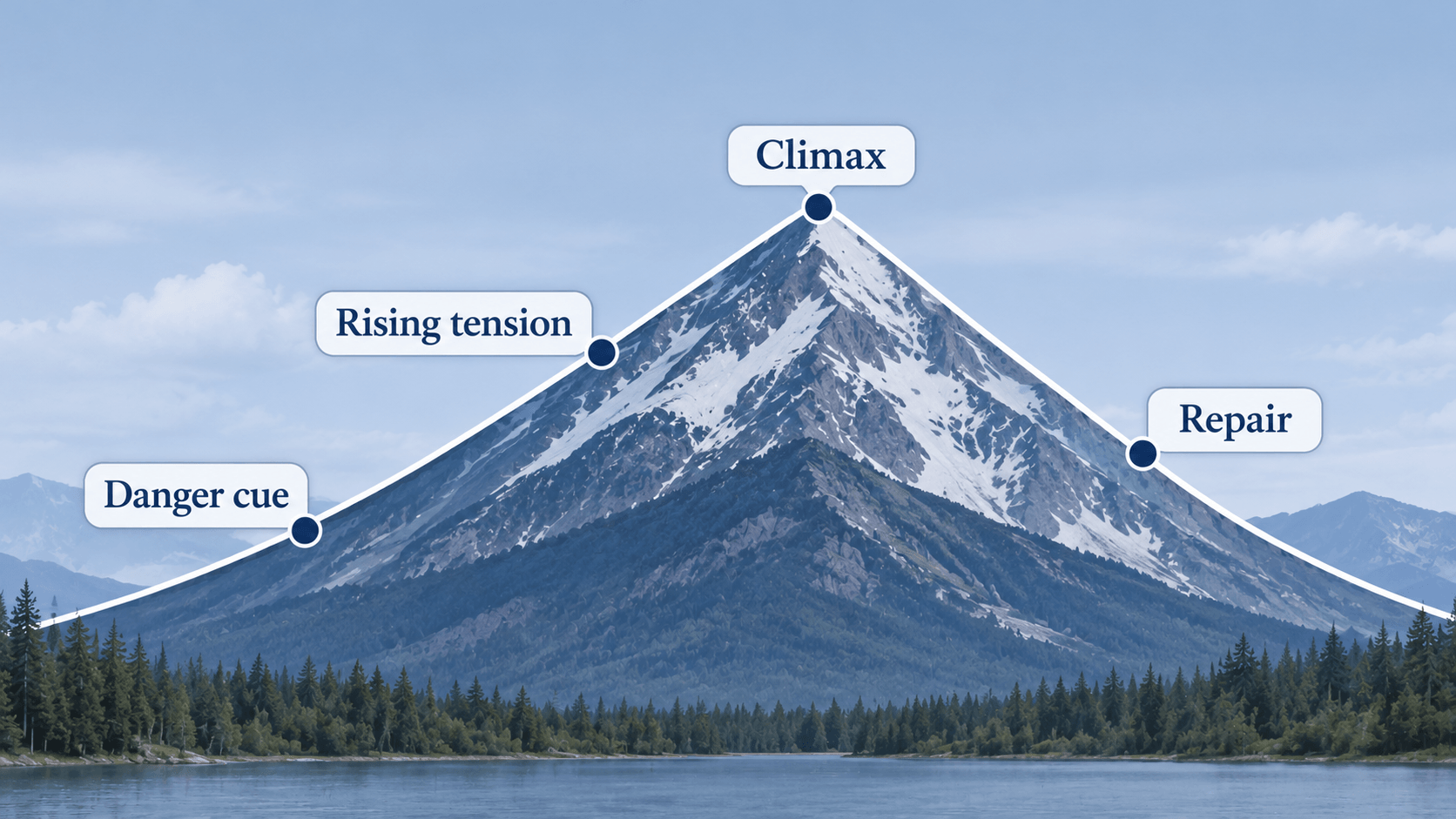
Slowing down and noticing the aim of each protective action can help each partner de-escalate the plot. Learning to listen deeply while also attending to one’s own sensation of danger and urge to self-protect is hard work! It involves recognizing and repairing the interaction earlier in the story, before the emotional intensity becomes so high that every word feels loaded. Instead of pushing harder when you feel dismissed, you might recognize your hurt and express your need more directly. Instead of withdrawing when you feel criticized, you might explain that you’re overwhelmed but want to understand.
The original problem may still need to be addressed, but it becomes much easier to work through when you’re not also fighting to feel safe, valued, and understood.
You Can’t Eliminate the Negative Cycle, but You Can Soften It
Loving, healthy couples get caught in negative cycles sometimes. This is part of a committed relationship! Stress, fatigue, and vulnerable topics can make old patterns more likely to emerge. The goal isn’t to prevent every disagreement or difficult feeling. It’s to make these cycles less intense, less frequent, and shorter-lived.
As Sue Johnson writes in Hold Me Tight, “The secret to stopping the dance is to recognize that no one has to be the bad guy” (Johnson, 2008). This captures an important principle: the negative cycle itself is the problem to work on together, rather than treating each other as the entire problem. You may not be able to prevent every negative cycle from starting. But you can learn to recognize the dance (or plot) sooner, soften your responses, and repair before the climax burns so hot.

How Couples Counselling Can Help
When you’ve been having the same arguments for years, knowing what you should do differently doesn’t always make it easy to change. Couples counselling provides a space to slow these interactions down, identify the negative cycle, and understand the vulnerable feelings beneath each person’s protective responses.
With support and practice, it becomes more workable to express concerns more effectively, listen without immediately defending, and recognize when a conversation needs a pause before it escalates.
At Blue Rock Psychology in South Calgary, we offer relationship-focused counselling for couples and individuals. Couples counselling offers a space to understand recurring conflict, strengthen emotional connection, and develop healthier ways of responding to one another. Individual counselling can provide the safety to self-reflect and process difficult emotions outside of the challenging moments with one’s partner. If you and your partner keep having the same arguments without finding a way forward, counselling may help you understand what’s keeping you stuck and begin creating a different pattern together.
Jodie Purnell, Registered Psychologist, Owner – Blue Rock Psychology
If you’d like to learn more about working with Jodie or another member of the Blue Rock Psychology team, feel free to reach out to us at hello@bluerockpsychology.ca.
References
Feeney, J. A., & Karantzas, G. C. (2017). Couple conflict: Insights from an attachment perspective. Current Opinion in Psychology, 13, 60–64. https://doi.org/10.1016/j.copsyc.2016.04.017
Johnson, S. M. (2008). Hold Me Tight: Seven Conversations for a Lifetime of Love. Little, Brown Spark.
Spengler, P. M., Lee, N. A., Wiebe, S. A., & Wittenborn, A. K. (2024). A comprehensive meta-analysis on the efficacy of emotionally focused couple therapy. Couple and Family Psychology: Research and Practice, 13(2), 81–99. https://doi.org/10.1037/cfp0000233
Weber, D. M., Fischer, M. S., Baucom, D. H., Baucom, B. R. W., Engl, J., Thurmaier, F., Wojda, A. K., & Hahlweg, K. (2021). Escalation and regulation of emotional arousal in couples predicts relationship satisfaction concurrently and 25 years later. Family Process, 60(1), 251–269. https://doi.org/10.1111/famp.12597